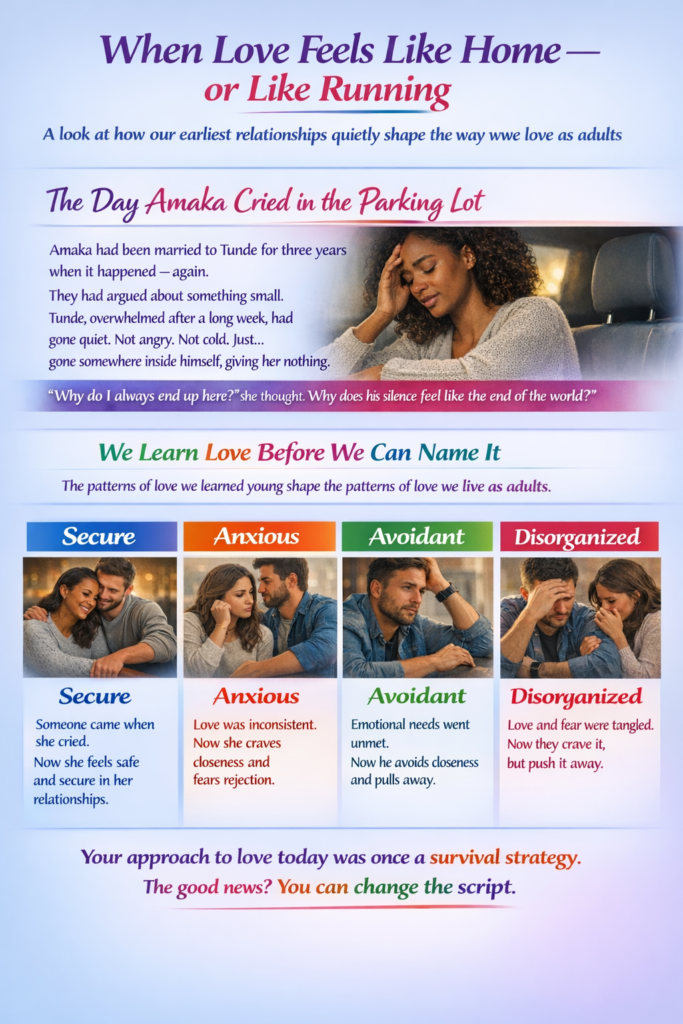
A look at how our earliest relationships quietly shape the way we love as adults
The Day Amaka Cried in the Parking Lot
Amaka had been married to Tunde for three years when it happened — again.
They had argued about something small. Tunde, overwhelmed after a long week, had gone quiet. Not angry. Not cold. Just… gone somewhere inside himself, the way he sometimes did. He sat on the edge of the bed, staring at the wall, giving her nothing.
And something in Amaka snapped.
She called his name three times. She touched his arm. She said “you always do this” and “you never let me in” and finally, when none of it worked, she grabbed her keys and drove to a shopping mall she had no intention of entering. She sat in the parking lot for forty minutes, crying in a way that felt disproportionate — even to her.
Why do I always end up here? she thought. Why does his silence feel like the end of the world?
The answer, it turns out, was about thirty years old.
We Learn Love Before We Can Name It
Long before we ever fall in love, we fall in love with our parents.
Not romantically — but structurally. The first relationship any of us ever has teaches us the rules of closeness. Is it safe to need people? Will they come when I call? Can I trust that love stays, even when someone goes quiet?
A British psychiatrist named John Bowlby spent decades studying this question in the 1950s. He found that babies are biologically wired to form deep bonds with their caregivers — not just for food and warmth, but for emotional safety. Those early bonds, he argued, become the template we carry into every relationship that matters.
Later, researchers discovered something striking: the patterns infants developed at six months old were still visible in the same people at thirty, forty, and fifty — playing out in their marriages, their friendships, their deepest fears about love.
We call these patterns attachment styles. There are four of them. And most of us have been living inside one our whole lives without knowing it.
The Child Who Learned to Trust
Imagine a little girl — let’s call her Sade. When Sade cried as a baby, someone came. Not every single time, but most of the time. Consistently enough for her nervous system to learn: people are reliable. The world is manageable. I am worth showing up for.
When Sade went to school, she could run off to play and trust that her mother would still be there when she turned around. When she fell and grazed her knee, she didn’t question whether to go to her mother — she just went.
Thirty years later, Sade is married to Emeka. When they fight — and they do fight — she gets upset, says what she needs to say, and eventually comes back to the table. She doesn’t catastrophise. She doesn’t wonder if this is the end. She gets hurt, then she gets curious: what is he actually trying to say? What do I actually need?
This is called secure attachment, and it is, in the language of research, the gold standard.
Securely attached couples tend to have the most stable marriages. Not because they fight less, but because they fight differently — and come back to each other more easily. Conflict doesn’t feel like annihilation. Disagreement doesn’t feel like abandonment.
The Child Who Learned to Hold On Tight
Now imagine a different childhood. Same love, but different delivery.
Chisom’s mother was wonderful — warm, funny, generous — but also unpredictable. Some days she was fully present, scooping Chisom into her arms the moment she cried. Other days she was distracted, or stressed, or somewhere else in her head entirely.
So Chisom learned to stay alert. She learned to watch her mother’s face for signs of availability. She learned that the way to get love is to want it loudly enough, often enough. Because if she went quiet, she might be forgotten.
Chisom grew up and married Kola. She loves him enormously — but she cannot stop watching his face. When he takes an extra twenty minutes to reply to a text, her stomach drops. When he goes out with his friends and seems happy without her, she feels a pang she can’t quite explain. When he’s tired and says “let’s talk tomorrow,” she hears: you don’t matter enough for tonight.
So she pushes. She comes back three, four, five times in the same evening, asking “are you okay with me?” She picks small arguments not because she wants to fight, but because a fight is at least connection. At least in a fight, he’s looking at her.
This is anxious attachment — and Chisom is not irrational. She is running a programme written in a child’s bedroom twenty years ago, where inconsistency meant you had to work hard to be loved.
In marriage, anxious attachment often looks like jealousy, reassurance-seeking, or emotional intensity that surprises even the person feeling it. Why am I crying this hard over a late text? Because somewhere inside, it isn’t really about the text.
The Child Who Learned to Need Nothing
Dapo, at seven years old, fell off his bicycle and split his chin open. He walked into the house, showed his father the blood, and his father barely looked up from the newspaper. “You’re fine,” he said. “Stop making a fuss.”
This happened in many forms over many years. Dapo learned quickly that his emotional needs were inconvenient. That needing comfort was weakness. That the safest version of himself was the self-sufficient one.
He became very good at being alone. He built a rich inner world, worked hard, was respected by everyone who knew him. People described him as “calm” and “independent.” He described himself as “not really needing much.”
Then Dapo got married. His wife, Ngozi, is warm and expressive and needs conversation — about feelings, about the relationship, about what they mean to each other. And Dapo, who genuinely loves her, finds this exhausting in a way he cannot explain. When she wants to talk about something that upset her, he goes still and quiet, like a door closing gently but firmly.
He is not punishing her. He is not cold. He is simply doing the only thing he ever learned to do with emotional intensity: turn it off.
This is avoidant attachment, and it is often the most misunderstood pattern in marriage. The avoidant spouse looks unbothered, but underneath is a person who learned that closeness costs too much — so they protect themselves the only way they know how.
When Anxious Meets Avoidant
Here is where it gets painful.
Chisom and Dapo didn’t marry each other in this story, but they might as well have. Across Nigeria, and across the world, anxious and avoidant people find each other all the time. Research suggests it may not be an accident.
The avoidant person is drawn to the warmth and openness of the anxious person — they’ve never let themselves want closeness like that, and it feels magnetic. The anxious person is drawn to the steadiness of the avoidant — this person won’t smother me, they think. They feel safe in a way that’s actually familiar.
But once they’re married, the very things that attracted them become the source of the wound.
Chisom reaches for Dapo. Dapo pulls back. Chisom reaches harder. Dapo walls up. Chisom is in the parking lot, crying at 9pm, wondering what is wrong with her. Dapo is in the living room wondering why nothing he does is ever enough.
Both of them feel unloved. Both of them are loving — in the only language they know.
The Hardest Pattern of All
Then there is the pattern no one likes to talk about.
Some children grow up in homes where the person who was supposed to be safe was also frightening. A parent who sometimes held them close and sometimes lost control. A home where love and fear lived side by side.
These children face an impossible situation. The person they need to run to is also the person they need to run from. Their nervous system never finds a resolution.
As adults, these are the people who want love desperately and flee from it at the same time. They push partners away, then panic when the partner actually leaves. They start arguments in the middle of good moments, as if they cannot trust something beautiful to last. They describe relationships as both everything and impossible.
This is called disorganised attachment, and it is the most painful of the four patterns. It is also the most likely to unravel a marriage — not because the person is unlovable, but because they are carrying wounds that require more than love alone to heal.
The Part That Changes Everything
Here is what took researchers decades to discover, and what still surprises people when they hear it:
Attachment styles are not permanent.
They were learned. And what was learned can, with time and the right support, be unlearned.
A good therapist — particularly in approaches like Emotionally Focused Therapy, which works explicitly with these patterns — can help couples step off the anxious-avoidant carousel. The anxious partner learns that it is safe to soften. The avoidant partner learns that closeness does not always end in pain. Both partners stop triggering each other’s oldest wounds and start building something new.
Even without therapy, a genuinely consistent and patient partner can slowly help rewire the nervous system. Research calls this earned security — the discovery, in adulthood, that love can be safe after all.
Amaka, sitting in that parking lot, eventually went home. She and Tunde found a couples therapist who helped Tunde understand that his silence wasn’t neutral — it landed on Amaka like abandonment. And helped Amaka understand that when she pushed and pushed, Tunde’s nervous system was not being cruel. It was being a seven-year-old boy told not to make a fuss.
They are still married. Still learning.
The Question Worth Asking
You don’t need a therapist or a textbook to start. You just need a moment of honest reflection.
When your partner is distant, what story do you tell yourself? They don’t love me. I’m too much. I always end up alone. Or: They’re probably tired. I’ll check in later.
When conflict rises, do you move toward the person you love — or do you find a reason to be somewhere else entirely?
The patterns you find there are not your fault. They were written before you had words. But you are old enough now to read them — and to choose, slowly, differently.
Because the person across the breakfast table is not your parent. And this marriage is not your childhood. It’s something you are both still building — and it is not too late to build it differently.