When Narcissistic Control Stops Working: The Psychology of Emotional Detachment
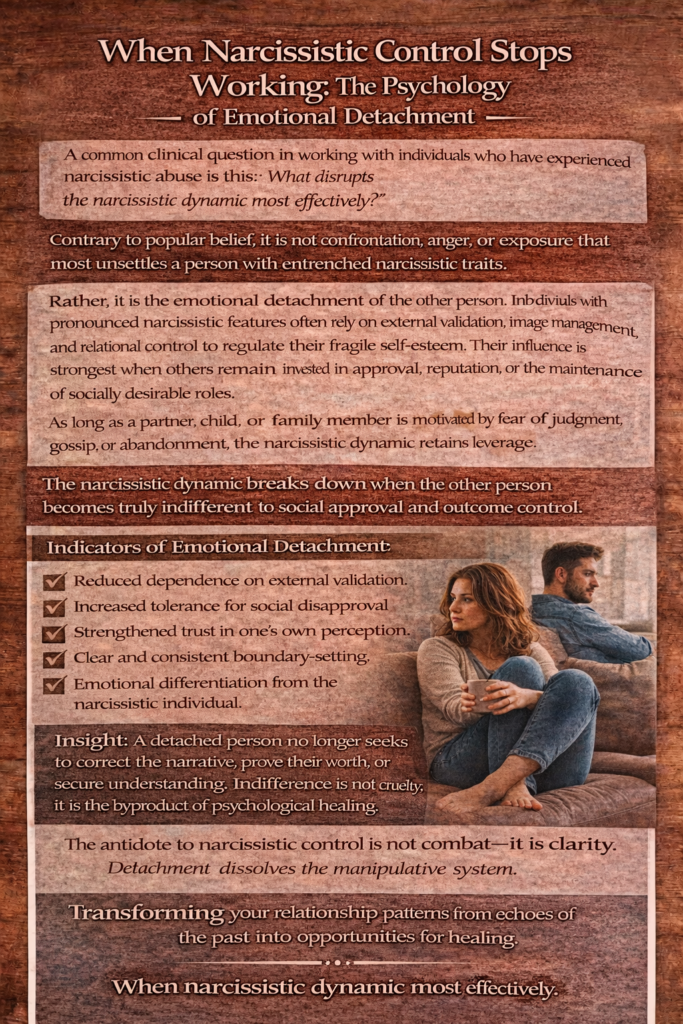
A common clinical question in working with individuals who have experienced narcissistic abuse is this: *What disrupts the narcissistic dynamic most effectively?*
Contrary to popular belief, it is not confrontation, anger, or exposure that most unsettles a person with entrenched narcissistic traits. Rather, it is the psychological emancipation of the other person.
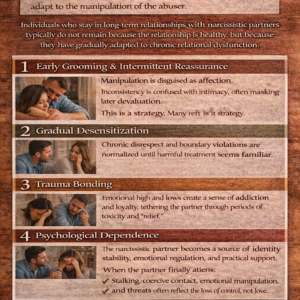
Individuals with pronounced narcissistic features often rely on external validation, image management, and relational control to regulate their fragile self-esteem. Their influence is strongest when others remain invested in approval, reputation, or the maintenance of socially desirable roles. As long as a partner, child, or family member is motivated by fear of judgment, gossip, or abandonment, the narcissistic dynamic retains leverage.
However, the dynamic begins to collapse when an individual undergoes a fundamental shift in self-definition.
This shift typically occurs after prolonged emotional strain. The person may have endured cycles of devaluation, gaslighting, and image distortion. Over time, survival requires relinquishing the performative roles that once sustained the relationship—the “good spouse,” the “obedient child,” the “perfect parent.” These identities, often maintained at significant psychological cost, are dismantled. What emerges instead is a more internally anchored self-concept.
From a clinical perspective, this transformation reflects several important developments:
* **Reduced dependence on external validation**
* **Increased tolerance for social disapproval**
* **Strengthened trust in one’s own perception**
* **Clear and consistent boundary-setting**
* **Emotional differentiation from the narcissistic individual**
Gaslighting becomes ineffective when a person has already questioned their reality, processed the cognitive dissonance, and rebuilt trust in their own perception. Manipulation loses power when explanations are no longer offered compulsively and boundaries are set without negotiation for approval.
What is often most destabilizing to a narcissistic personality structure is not overt hostility but emotional detachment. When the other person no longer seeks to correct the narrative, prove their worth, or secure understanding, the primary mechanisms of control dissolve.
Indifference, in this context, is not cruelty. It is the byproduct of psychological healing. It reflects the movement from reactive engagement to self-regulated autonomy.
In therapeutic terms, this stage marks a transition from survival-based relating to differentiated functioning. The individual is no longer organized around managing the narcissist’s perception. Instead, they are oriented toward internal coherence and self-trust.
When this occurs, the narcissistic dynamic cannot operate in its usual form. Control requires emotional investment. Without it, the system loses its reinforcement.
Ultimately, what disrupts narcissistic control is not combat—it is clarity.