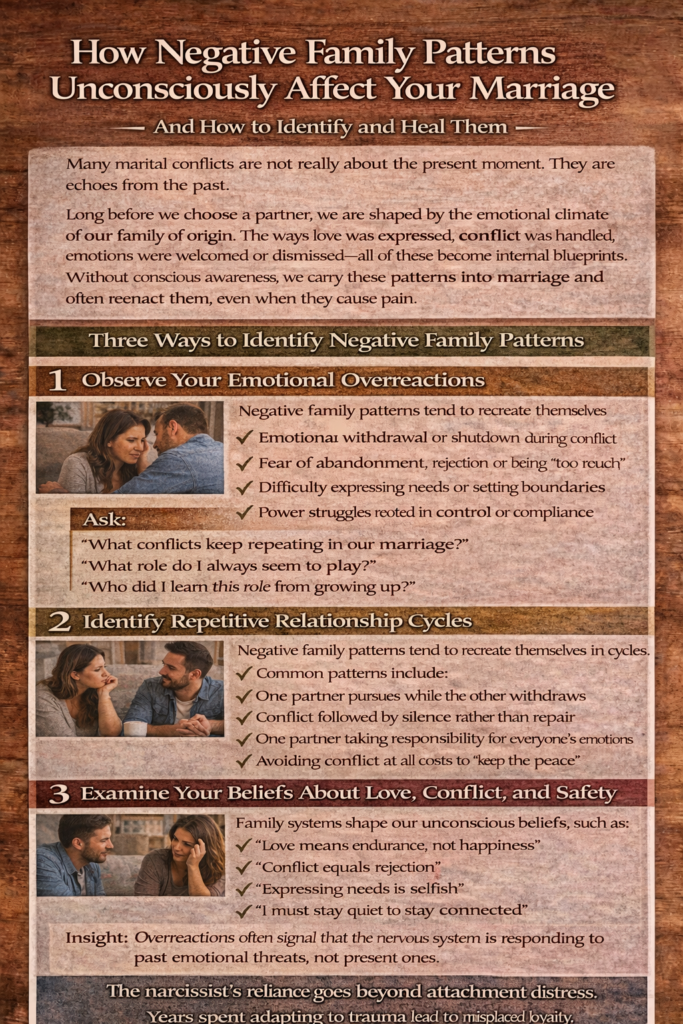
HOW NEGATIVE FAMILY PATTERNS UNCONSCIOUSLY AFFECT YOUR MARRIAGE
And How to Identify and Heal Them
Many marital conflicts are not really about the present moment. They are echoes from the past.
Long before we choose a partner, we are shaped by the emotional climate of our family of origin. The ways love was expressed, conflict was handled, emotions were welcomed or dismissed—all of these become internal blueprints. Without conscious awareness, we carry these patterns into marriage and often reenact them, even when they cause pain.
Negative family patterns do not announce themselves loudly. They operate quietly, unconsciously, influencing how we interpret our partner’s words, respond to stress, and define what feels “normal” in love.
How Negative Family Patterns Show Up in Marriage
Unresolved family dynamics can appear in marriage as:
• Repeating the same arguments with no resolution
• Emotional withdrawal or shutdown during conflict
• Fear of abandonment, rejection, or being “too much”
• Difficulty expressing needs or setting boundaries
• Power struggles rooted in control or compliance
• Choosing familiar pain over unfamiliar emotional safety
Often, partners assume the problem is incompatibility—when in reality, both are responding from old survival strategies learned in childhood.
Three Ways to Identify Negative Family Patterns
1. Observe Your Emotional Overreactions
Strong emotional reactions are often clues to unresolved family patterns.
Ask yourself:
• “Why does this situation feel bigger than it should?”
• “What am I afraid will happen right now?”
• “Have I felt this way before—long before this relationship?”
When a minor disagreement triggers intense anger, shame, or panic, it may not be about your partner—it may be about an old emotional wound being activated.
Insight: Overreactions often signal that the nervous system is responding to past emotional threats, not present ones.
2. Identify Repetitive Relationship Cycles
Negative family patterns tend to recreate themselves in cycles.
Common patterns include:
• One partner pursues while the other withdraws
• Conflict followed by silence rather than repair
• One partner taking responsibility for everyone’s emotions
• Avoiding conflict at all costs to “keep the peace”
Ask:
• “What conflicts keep repeating in our marriage?”
• “What role do I always seem to play?”
• “Who did I learn this role from growing up?”
These patterns are often inherited—not chosen.
3. Examine Your Beliefs About Love, Conflict, and Safety
Family systems shape our unconscious beliefs, such as:
• “Love means endurance, not happiness”
• “Conflict equals rejection”
• “Expressing needs is selfish”
• “I must stay quiet to stay connected”
Ask yourself:
• “What did love look like in my home growing up?”
• “How were anger, sadness, or disagreement handled?”
• “What was unsafe to express?”
What was normalized in childhood often becomes repeated in adulthood—until it is examined.
How to Address and Heal Negative Family Patterns
1. Bring Patterns into Conscious Awareness
Healing begins with naming.
Instead of blaming your partner, shift the question from:
• “What’s wrong with us?”
to
• “What pattern is being activated right now?”
Language such as:
“This feels familiar from my past”
“I think this is an old survival response”
creates space for compassion rather than conflict.
2. Regulate Before You Relate
You cannot heal family patterns while emotionally flooded.
Practice:
• Pausing before reacting
• Grounding through slow breathing
• Naming emotions instead of acting them out
When the nervous system feels safe, the adult self—not the wounded child—can respond.
Remember: Regulation is not avoidance; it is preparation for healthier connection.
3. Create New Relational Experiences
Old patterns heal through new emotional experiences.
This may include:
• Practicing emotional validation instead of dismissal
• Repairing after conflict instead of withdrawing
• Setting boundaries without guilt
• Allowing vulnerability without punishment
Consistent, safe emotional responses slowly retrain the nervous system to expect connection rather than threat.
Final Reflection
Negative family patterns do not mean you are broken—they mean you adapted.
What once helped you survive childhood may now be interfering with intimacy. Marriage often becomes the mirror that reveals what was never healed, not to punish us, but to invite growth.
When couples courageously explore their inherited patterns, marriage can transform from a battlefield of old wounds into a space of conscious healing, emotional safety, and deeper connection.