Why Long-Term Narcissistic Relationships Are So Hard to Leave.
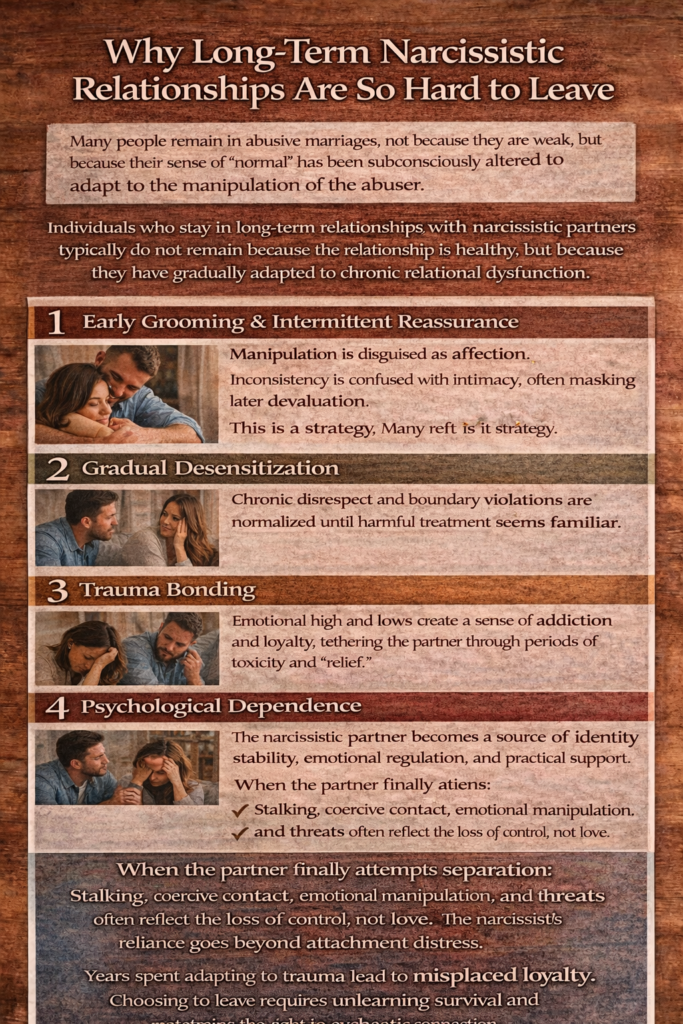
Many people remain in abusive marriages, nit because they are good people, but because they have subconsciously adpted to the behaviours of the abuser, without knowing it.
Individuals who remain in long-term relationships with narcissistic partners often do so not because the relationship is healthy, but because they have gradually adapted to chronic relational dysfunction.
In the early stages, patterns of devaluation may be confusing or intermittently masked by periods of reassurance or affection. Over time, the non-narcissistic partner may rationalize these behaviors, defend them, or internalize the explanations provided. This adaptive response is especially common among individuals with a history of childhood trauma, emotional neglect, or unstable caregiving environments, where inconsistency and emotional insecurity were normalized early in life.
As the relationship progresses, repeated exposure to invalidation, emotional withdrawal, and boundary violations leads to desensitization. What was once perceived as harmful becomes familiar. In clinical terms, the individual’s baseline expectations for emotional safety, reciprocity, and respect are significantly lowered.
Within this context, minimal positive behaviors—such as brief attentiveness, reduced absence, or temporary compliance—may be experienced as meaningful affection. These behaviors are not objectively reparative, but they contrast so strongly with prolonged emotional deprivation that they are perceived as relational success. The individual is not responding to healthy connection, but to relief from distress.
From a narcissistic personality dynamic, long-term partners offer significant psychological advantages. The relationship no longer requires sustained effort, empathy, or self-regulation. Behaviors that would typically prompt concern or disengagement in new relationships are tolerated within the established one. This dynamic allows the narcissistic partner to maintain a sense of control and entitlement while minimizing accountability.
Additionally, the presence of a long-term partner often provides stability, emotional labor, and practical support, allowing the narcissistic individual to seek admiration or validation from alternative sources without disrupting their primary attachment structure.
This dynamic helps explain the intensity of reactions often observed when a long-term partner initiates separation. Behaviors such as stalking, coercive contact, emotional manipulation, threats of self-harm, or character attacks are not expressions of healthy attachment distress. Rather, they reflect the perceived loss of a critical regulatory and containment figure—someone who absorbed emotional volatility, maintained stability, and tolerated behaviors others would not.
Clinically, the narcissistic partner is responding not only to abandonment, but to the loss of a relational role that provided security without requiring mutuality.
Understanding this dynamic is essential in therapeutic work. It reframes the relationship not as a failure of endurance or loyalty, but as a conditioned adaptation to chronic emotional injury. Treatment focuses on restoring accurate relational expectations, strengthening boundaries, and helping clients differentiate between attachment, trauma bonding, and genuine intimacy.