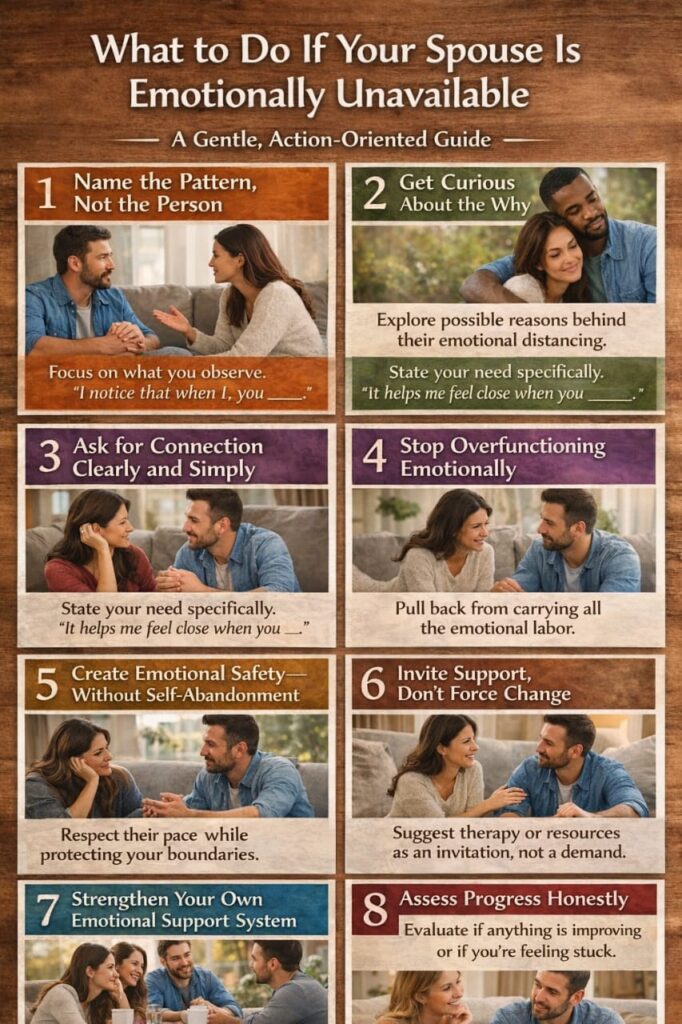
What to Do If Your Spouse Is Emotionally Unavailable
A Gentle, Action-Oriented Guide
Discovering that your spouse is emotionally unavailable can feel painful, confusing, and deeply lonely. You may wonder whether to try harder, pull away, or give up entirely. This section offers grounded steps you can take—without losing yourself in the process.
1. Name the Pattern, Not the Person
Instead of labeling your spouse as “cold” or “uncaring,” focus on what you observe.
Don’t say, you never care about how I feel.”
Rather say, I notice that when I share my feelings, the conversation often ends quickly.”
Interactive exercise:
Write one pattern you’ve noticed without using blame words:
“I notice that when I __________, you __________.”
This opens the door to dialogue rather than defensiveness.
2. Get Curious About the Why
Emotional unavailability is often a protective strategy, not a lack of love.
Possible roots include:
Growing up in emotionally restrictive homes
Past betrayal or unresolved trauma
Fear of dependence or vulnerability
Learned beliefs like “emotions are weakness”
Reflect:
Has your spouse ever shared stories that suggest emotions were unsafe or discouraged in their past?
Curiosity builds compassion—but remember: understanding does not mean tolerating emotional neglect
3. Ask for Connection Clearly and Simply
Emotionally unavailable partners often miss indirect cues. Be specific and concrete.
Instead of:
“I just want you to be there for me”
Try:
“When I’m overwhelmed, it helps when you listen without trying to fix it.”
“I need 10 minutes of uninterrupted conversation tonight.”
Interactive prompt:
Finish this sentence and practice saying it calmly:
One way you could support me emotionally is __________.”
4. Stop Over functioning Emotionally
When one partner carries all the emotional labor, resentment grows.
Over functioning looks like:
Constantly explaining your feelings
Chasing emotional responses
Apologizing for having needs
Self-check:
Ask yourself: ‘Am I trying to earn emotional availability by shrinking myself?
Pulling back from over-giving creates space for healthier dynamics.
5. Create Emotional Safety—Without Self-Abandonment
Emotionally unavailable spouses often open up slowly when they feel safe.
Safety includes:
Calm tone
Predictable responses
Respect for emotional pacing
But safety does not mean:
Suppressing your feelings
Accepting chronic neglect
Walking on eggshells
Boundary reflection:
What emotional boundary do you need to protect your well-being right now?
6. Invite Support, Don’t Force Change
You cannot make someone emotionally available but you can invite growth.
Options include:
Couples therapy
Individual counseling
Relationship workshops or books
Conversation starter:
“I value our marriage and think getting support could help us connect better. Would you be open to exploring that together?”
Their response will give you important information.
7. Strengthen Your Own Emotional Support System
Do not isolate yourself while waiting for your spouse to change.
Actively nurture:
Trusted friends
Mentors
Support groups
Therapy or coaching
Interactive check-in:
List three safe places where your emotions are welcomed and validated.
Your emotional health matters.
8. Assess Progress Honestly
Change is shown through consistent effort, not promises.
Signs of progress:
Willingness to listen
Attempts at emotional engagement
Openness to help
Signs of stagnation:
Repeated dismissal
Mocking emotional needs
Complete refusal to engage
Reflection question:
If nothing changes in the next year, how would that affect your emotional well-being?
This is not a threat, it’s clarity.
Final Encouragement
Loving someone who is emotionally unavailable is exhausting—but you are not asking for too much. You are asking for connection, which is foundational to marriage.
Healing may involve:
Mutual growth
Professional support
Or difficult decisions about boundaries and sustainability
Whatever path unfolds, your emotional needs are valid and worthy of care.